
The
Ming Dynasty

THE MING
DYNASTY

What is Ming Dynasty?
The Ming Dynasty was the ruling dynasty of China - then known as the Great Ming Empire - for 276 years, following the collapse of the Mongol-led Yuan Dynasty. The Ming Dynasty was the last imperial dynasty in China ruled by ethnic Han Chinese. Although the primary capital of Beijing fell in 1644 to a rebellion led by Li Zicheng (who established the Shun Dynasty, soon replaced by the Manchu-led Qing Dynasty), regimes loyal to the Ming Throne - collectively called the Southern Ming - survived until 1683.
Geography
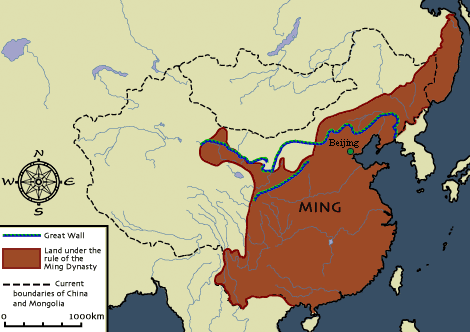
The Ming Dynasty (1368-1644) was, after more than 400 years, the first
that was able to reunite China under a native government. Its first capital Jingshi of Ming Dynasty was located in Modern Nanjing, Jiangsu. The Yongle Emperor (r. 1403-1424) decided to move the capital to the north, partially to get rid of the domination of the southern elite, but also, to be closer to the frontier to the Mongols, and be able to control them in a more efficient way. The new capital was and ancient site of the capital of the Yuan Dynasty (1279-1368). It was called "Northern Capital" Beijing, and is identical to the Modern Beijing. The former, now "Southern Capital" Nanjing was from them on the secondary capital of the Ming Empire.
The Ming Empire was divided into provinces(sheng), an institution that had been created as local ad-hoc copies of the central secretariat during the phase of conquest. The names, sized and seats of the Ming provinces are largely identical to those of modern China. The provinces were divided into supreme prefectures (fu) and secondary prefecturs (zhou).

Religions
The Ming Dynasty had six religions. Those are Buddhism, Confucianism, Islam, Taoism, Catholic Church, and Chinese Folk Religion. Buddhism is the world's fourth- largest religion over 520 million followers, or over 7% of the global population, known as buddhist. It was brought by China by Buddhist monks from India during the latter part of the latter part of the Han Dynasty (ca. 150 CE) and took over a century to become assimilated into Chinese culture. One of the key forces of Buddhism's success was Daoism. ...Both Buddhism and Daoism benefited from this exchange. Confucianism, also known as Ruism, is described as tradition, philosophy, a religion, a humanistic religion, a simply way of life. Islam, is an Abrahamic monotheistic religion teaching that there is only one God and that Muhammad is the messenger of God. Taoism, a religious tradition of Chinese origin which emphasizes living in harmony with the Tao. Catholic Church, is the largest Christian church, with approximately 1.3 billion baptized Catholics worldwide, as of 2016. Chinese Folk Religion is the religious tradition of the Han people, including veneration of natures and ancestors.
06
Religions in Ming Dynasty
11
Gods in all religions of Ming Dynasty
ACHIEVEMENTS


The Forbidden City was built during the reign of Yongle Emperor
Seven Epic Voyages were led by the great Chinese admiral Zheng He
Majority of the existing Great Wall of China was built in the Ming Era
The famous Porcelain Pagoda of Nanjing was built during Ming Era
MING DYNASTY'S GOVERNMENT AND POLITICS
T
he Ming Dynasty's Government & Politics. The Ming's Dynasty built the Forbidden City in Beijing. The Ming Dynasty, which ruled China from 1638 to 1644, came to power after a century of foreign domination. It was a government led by ethnic Han Chinese that replaced the earlier Mongol Yuan Dynasty.


Economy of the Ming Dynasty

Coins were made from silver imported from Spanish Empire
The Old Beijing during Ming Era
